Showing posts with label Fond pour les Femmes Congolaises. Show all posts

18 September 2012

Just 3 Mamas with an Idea

On Saturday Jill and I met with our dear friend Laure. You remember her, the obstetrician at the Promesse de Dieu clinic out in the countryside. We've started working with her to draw-up the plans for a maternal education project with her patients. She's going to write a proposal to these guys and hope to secure some funding. We're going to help. Jill's got the nursing expertise. I've got a master's degree that says I know how to plan projects. And Laure's pretty much the strongest, smartest person we know.


 Saturday afternoon found Laure 9 months pregnant with her 6th child. Her husband has just started chemotherapy for a cancer that may take his life. Still, she was insistent we meet and discuss. We sat on Jill's back porch and threw around ideas for a maternal education program similar to the model of group prenatal care. You can read more about it here and here.


Laure loves it. She wants to spend more time educating her patients. She wants safe deliveries and healthy babies. Seems simple enough, but when you don't have much, it's a daunting task.

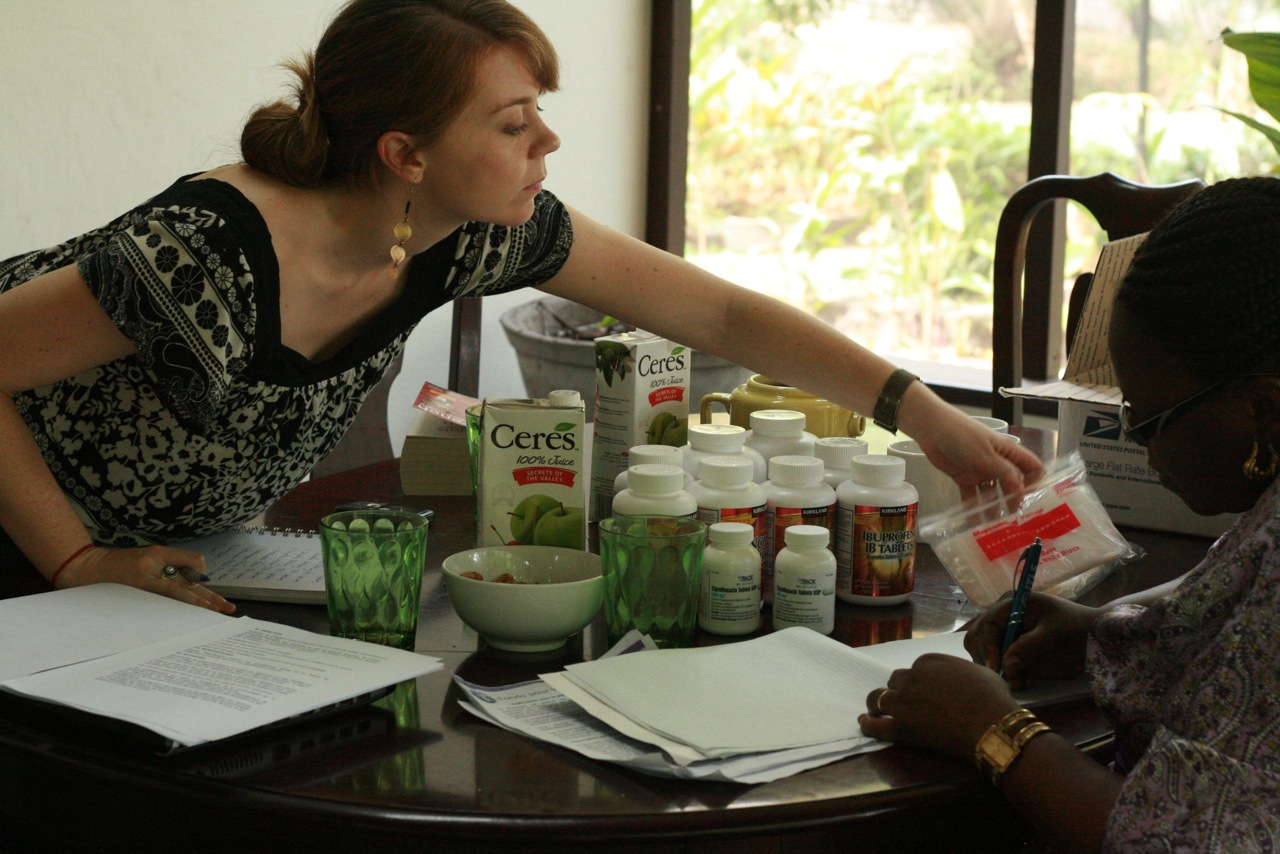
We also launched a mini-project and handed over some medical donations, thanks to you, dear readers who were inspired by Laure's work and our previous posts. Promesse de Dieu will be stocked with basic supplies to keep babies and mamas a little bit healthier this year.


P.S. If you have an idea or are interested in supporting our little project somehow. Get in touch with us!  We especially welcome know-how regarding group prenatal care and Centering Pregnancy for socially high-risk populations...(expert friends, we know you're out there!)


19 July 2012

I Have a Nanny.

I realize that being back in the U.S., I am guarded in how I describe Mama Vida.  Like this:

Person who lives in U.S.:  Wow!  Great Pili-Pili.  Who did you say made this?
Me:  Mama Vida made it.  She's our...Lou Lou's...the woman...the person...   

Usually, I end up saying that she's "the person who watches Lou Lou", and often, "our nanny" but it usually takes me a bit to get around to it.  Do I define her using the possessive "our"?  Does "the person who watches Lou Lou" give her anywhere near the credit she deserves?  She's one of the people who knows us best, but do I call her a "friend"?  We love her, but does she love us?  Is this business or relationship? 


(This article touches on these feelings. Reading about "The Other Mothers of Manhattan" is what got me writing this post...)


Mama Vida is an essential and central person to our life in the Congo and I want to give a proper description when I talk about her.  I just almost always do a bad job.  I worry that people will think that if I casually throw around "our nanny" that I sound impossibly privileged (which I am).  I used to secretly think that my third-culture-kid friends were kind of awful when they mentioned the slew of housekeepers, nannies, and guards that surrounded their childhoods.  Especially the former missionary kids.  Really? Missionaries who have house help?

Now, I don't judge so much on this topic.


Mamas Vida and YouYou have helped me get over any qualms that I might have identifying as an employer.  When a TASOK resident chooses not to hire a gardener, housekeeper, nanny, or other possible house worker, they are all over that situation.  They want to know why.  They know the perfect person for the job.  Why would someone at the American school not want to provide a job if they have the opportunity?

For us, we consider worker salaries the best money we spend each month.

When we left Kinshasa for the summer, Mama NouNou pulled me aside to tell me how the income she makes working at our house has changed the way her family lives.  Not dramatically, but enough to allow them to stop just figuring out how to just get through the day and start thinking about the future.

NouNou (a trained chef/caterer) told me all about how she wants to start a system of portable lunch trucks.  She noted that many of the mass employers don't provide lunch options to the workers.  And because the factories are self-contained, it isn't easy to just walk somewhere to purchase a quick meal.  She explained how this would be a woman-owned, woman-run business, giving jobs to some of the most-vulnerable, least-employable populations: the older women and mothers.  Because it would be lunch-only, mothers could be home in time to meet their kids after school.  Older women could watch the babies while the younger women cooked, served, and washed up.  They would serve a simple menu of old favorites:  fufu, pondu, baguettes, and beans.


Basically, NouNou has re-imagined the food truck scene for Kinshasa:
Original logo from the Philadelphia Food Truck Association.

I think Sarah and I will help her write up her idea into a proposal this Fall and submit it to Le Fonds Pour Les Femmes Congolaises for business support and funding.  

She would rock the Kinshasa lunch scene.

I sort of hate myself for writing this piece.  I hate to imagine painting myself as the wealthy benefactor, waxing eloquent about how I've made life better for "my workers".  Ugh.

But, I also want to crazily appreciate everyone who helps us in Kinshasa.  Yes, it's a business arrangement.  Yes, there are power imbalances.  No, I don't know how to exactly define our relationships.  But, I really hope it's good for everyone involved.

27 March 2012

The Reality of Maternity. (A Visit to the Clinic.)

Remember when we mentioned that we were planning a visit to a small maternity clinic outside of the city?

Well - we went.  We listened.  We talked.  We took pictures.  We watched.

Dr. Laure, a Kinshasa-trained OB/GYN, was our host.  She met us by the side of the road, her little daughter, Maleka,on her hip.  We piled into the blue Suzuki Jimny (gotta love that car) and rattled off down the dirt paths that form the outskirts of the city - near Lac de Ma VallĂ©e.  Dr. Laure had to ask directions several times.  Because she never drives and always walks to work.  Getting there via road is a very different process than on foot.

Finally, Adam (our trusty driver), Sarah, Dr. Laure, baby Maleka, and myself unloaded ourselves here:


This is the little clinic. Just two Kinshasa-trained physicians work here. Dr. Laure is an OB/GYN but can hold her own in most any other field.  Dr. Maurice has trained in surgery and internal medicine. They make about 2,000 FC ($2.16) per month profit.  (Laure told me that a "fancy city doctor" makes about $1000/month in Kinshasa).  It serves the population living within 10km on all sides.  A lot of people.  It is a "charity" clinic.  Meaning - they will take those who the city hospitals turn away.  In Kinshasa, if you can't pay, you are often turned away.  Simple as that.  Doesn't matter if you are on death's doorstep, a small child, or a woman in labor.  There is no EMTALA in the Congo.

For example, we arrived at the clinic along with another car.  This tiny car, it's chassis hanging and scraping, parked next to us.  Two men extracted a broken, angry body from the back seat.  When we discussed it later, all of us had the same experience of looking at this injured person and having visceral knowledge that there was something horribly wrong but being unable to exactly identify the issue.  Later, it was clear that both of his legs were severely broken.  Bent.  Twisted grotesquely.

We learned that he had been in a motorcycle accident five days prior.  He was poor.  He didn't even try to go to another hospital.  Finally, after five days of broken dangling legs and pain, friends or family loaded him into a car and drove him to Dr. Laure and Dr. Maurice.  While we were there, both physicians regarded the x-rays.  They knew the solution:  surgery, a few pins and plates, and a long, but complete recovery.  They also knew that none of this was an option for this patient.  They didn't have equipment.  He didn't have money.  His reality was permanently unusable legs, loss of any prospect of future income, and chronic pain.

Dr. Laure explained the scene matter-of-factly and with genuine sadness.  She then ushered us into the tiny cement hospital for a tour.  We met Nurse Terese - who would work three, solo, 24-hour shifts before her replacement arrived.  She changed dressings, served as a surgery first-assist, held flashlights for procedures in the dark, and cleaned rooms. 

We spent a lot of time taking in the salle d'accouchement - or delivery room.


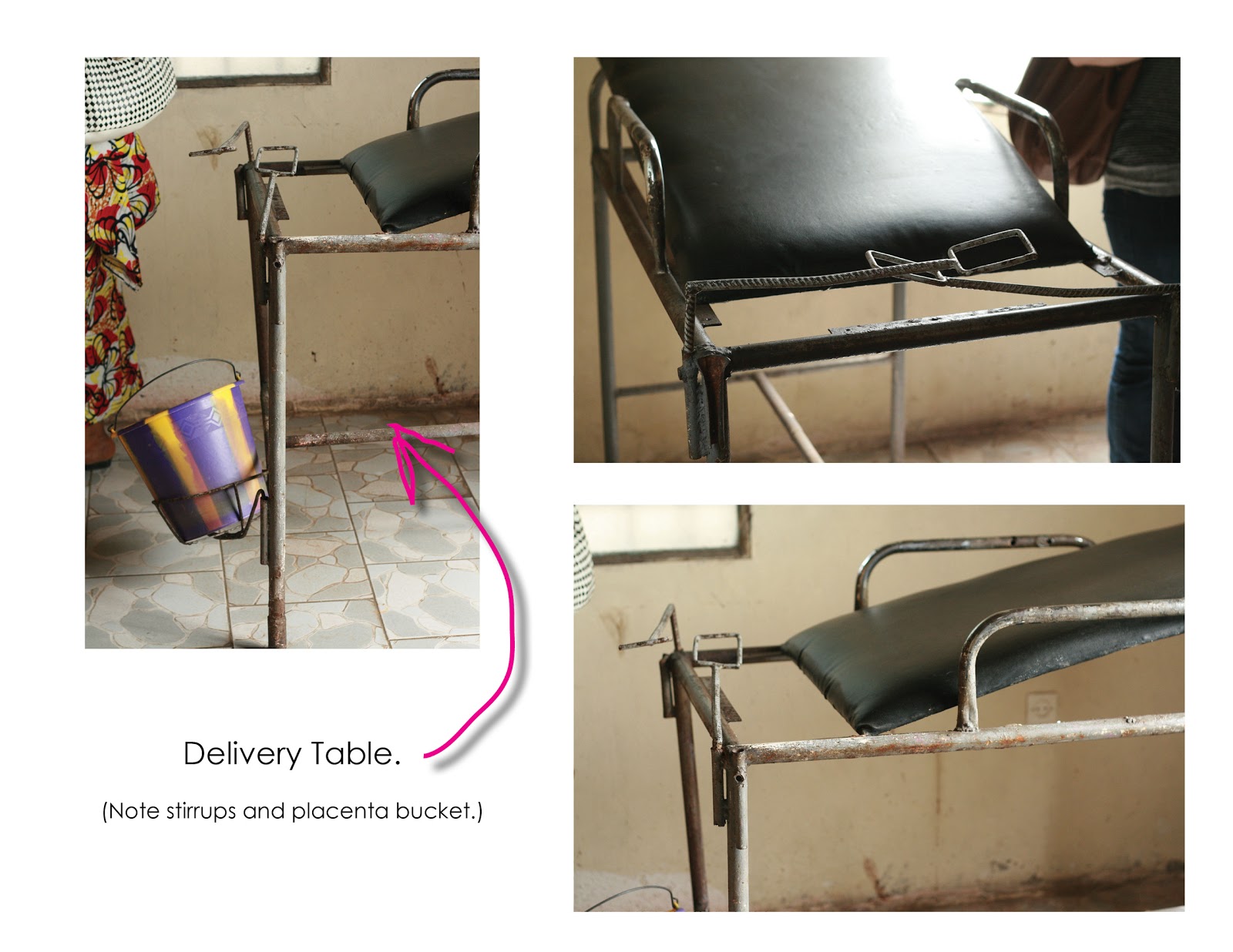
Now, Sarah and I have a little experience (i.e. one time) with Congolese clinic delivery rooms and we both agreed that, compared to the dank, unbearably hot, crowded city delivery space where we assisted in a delivery last Fall - we would give birth at this clinic any day.  Sure, it's plain.  The equipment is old.  The beds seem impossible for a laboring woman.  But, it's light and breezy and cool.  Everything is kept as clean as possible.  And the care is expert and calm. 

Dr. Laure and Terese were quick to point our the shortcomings of this place in which they work.  They asked to have their photo taken.  In preparation, the arranged all of the labor and delivery instruments, medicines, and equipment into a little pile on the table beside them.  They wanted you - the readers of this blog- to see that this was all they have:


  • 1 pair scissors.
  • 1 pick-up/tweezers.
  • 1 bulb syringe (for sucking out baby's mouth and nose).
  • 2 clamps (for the umbilical cord).
  • 1 syringe.
  • 1 needle.
  • 1 stainless canister (used with a little rubbing alcohol and fire for sterilization of equipment.)
  • 1 pack of matches.
  • 1 mostly-empty bottle of isopropyl alcohol.
  • 1 half-full bottle of Ketamine for emergency anesthesia.
  • 1 old vial of Lidocaine for numbing skin
Luckily, most babies can come into this world without much fuss.  They don't require much more than what Dr. Laure can offer at her clinic.  She brings skill and patience, and usually, this is sufficient for a safe delivery.  

However, every midwife or doctor knows that some basic strategies are needed when things don't go "perfectly".  We talked a lot about the common - theoretically easy-to-manage, complications of labor and delivery.   Pitocin, Methergine, or Cytotec for heavy bleeding after delivery are not usually available.  Dr. Laure knew all about the up-to-date uses of these drugs, but did not have them at her side.  A patient's family may make a trip to the pharmacy for medications - if they have enough money and enough time.  Dr. Laure said that the clinic frequently gives out their limited stock regardless of a patient's ability to pay.  But, the reality is that the clinic doesn't have any money either.


Some of you reading may be Labor & Delivery nurses.  My colleagues from Virginia and Washington.  Right now, you are horrified.  Right?  One syringe for eveyone!?  Matches and alcohol for "sterilization"?!

But - ask yourself.  What would you do?  Not suck out the mouth of a sputtering newborn with a dirty bulb?  Not administer lifesaving oxytocin with the dull, oft-used, needle?

For Dr. Laure, the answer is easy.  She knows full-well that her little clinic is sorely lacking.  She would accept donations of expired medications and equipment from fancy U.S. hospitals - where we throw out unused supplies in the name of quality control - with a joyful relief.  But, she's not begging.  She will continue to serve these women and their babies with or without the supplies. She won't turn anyone away.

Sarah talks with Dr. Laure in the salle d'accouchement

I had a funny telephone conversation with Dr. Laure last week.  The connection was bad.  The children were screaming.  My French is bad.  She was calling to see what day I would be available to help with next month's prenatal clinic.  I understood that much and responded with my strategy of using all of my French vocabulary at once in an effort to convey deep appreciation and excitement.  Hopefully, it was effective.

So, Sarah and I will trek out to the hospital again in April.  We'll take some blood pressures (I'm starting Sarah's medical training tout de suite), measure some bellies, and listen to some heartbeats (although, I'm not sure Dr. Laure owns a doppler...).  School nursing is lovely.  Truly.  But, I've been waiting for the chance to work with moms and babies again.  Waiting around for an opportunity.  And it seems, this is it.

What Dr. Laure and her hospital really need is a sustainability plan.  For this, she is in touch with an amazing new local organization (I wrote about it here), Fond pour les Femmes Congolaises.  They exist to help Congolese women help Congolese women.  Dr. Laure is a perfect candidate.  

Shout out to Martha Jefferson Hospital! While donations aren't the answer to all of Dr. Laure's needs, it's not like she wouldn't put an old Doppler or some just-expired oxytocin to good use...  What are our options?  Any chance MJH L&D unit could gather up a few supplies for Dr. Laure by summer?  I will deliver them personally when we return next Fall.  Contact me if you have any brainstorms...


6 March 2012

the run.

I was recently put in charge of a run.
I'm not a runner (unless you count my lazy attempts at running "the wall" - more on that later), but here I find myself in charge of a benefit run.

This run is an institution at The American School of Kinshasa.  Begun several years ago, it was inspired by a parent's desire to use the campus to benefit the community.  I have a lot to live up to!  For the past several years the event has been part of Run for Congo Women: A global run/walk movement benefiting Women for Women International’s Congo program.

                                               
Run for Congo Women is a good thing (Oprah likes it!).  Women for Women International is doing good things in the Congo.  For sure.

But - it felt a little weird to hold a run where the money raised was mailed to the U.S. so that it could be repackaged and sent back to the Congo.  It seemed inefficient.

So, I did some searching to try to estimate how much of our money would likely make it back to our Congolese neighbors if we did participate in Run for Congo Women again.  From what I could figure (because these organizations are respectably transparent about their financial information), the journey our money would make would hypothetically go something like this:

1.) Our school raises $2000 through a Run For Congo Women event. 
2.) We keep costs low through donations, but there is still around $200 overhead = $1800.
3.) We mail $1800 to Women for Women International's Global Support Center in New York.  "An average of 75% goes [to the Congo program]" = $1350. 
4.) Women for Women International processes our donation.  Around 24% goes towards necessary operations fees = $1012.50 comes back to the Congo to support WFWI's Congo program.


Now.  I'm totally opening up a can of international-globalization-aid-based economy-developing nation-economic worms.  I know.  But unless you simply ignore it (and we all do this sometimes), it's hard to do anything in Kinshasa without these issues staring you in the face (remember my cereal saga?)

Educated folks confirm that if this little run is trying to basically raise funds for our neighbors, we should work with a local organization. 

Kinshasa is crawling with NGOs, international aid organizations, mission outfits, you name it.  There are many people who could make good use of a donation from our event.  My goal was to find a  way to combine the run's original vision of serving Congolese women with a new dedication to local, sustainable, partnership.  In order to find something trustworthy I talked with my friend Anna.  Who talked with her friend Sophie of the Carter Center. Sophie, without hesitation, suggested we chat with Gabrielle of Fond pour les Femmes Congolaises (FFC).


The FFC is located right in our own neighborhood of Ngaliema here in Kinshasa. (We will literally drive our donation down the road!) Here's how Gabrielle describes her organization:

The fund's vision of building a Congo where women have the right to bodily integrity, economic justice, and participation at all levels in decisions that affect their lives and their communities.
As to the purpose, it mobilizes resources contributing to the development of collective action by Congolese women for impact - visible and holistic - in the lives of Congolese women and their communities.
She has been terribly patient with my dreadful French in emails to her - so I'm already grateful and looking forward to working closely with her.  Here in Congo, we've found a great solution to who will be the beneficiary of this event.

However, if you are reading from the U.S. or the U.K., I encourage you to find a Run for Congo Women near you.  Yes, I did just tell you about that pesky 25% that inevitably goes towards "operations,"  but actually,  25% is respectable considering the type of organization.  These efforts know their audience.  They know that it's super hard to get people to care about big issues in other parts of the world.  They know they have to spend money on looking pretty in order to garner support and participation. So, while it's not ideal for us already here in the Congo to collaborate with them, you in Virginia, Washington, London, Texas, and New Mexico...you should! 


More later...

Let us know if you sign up to participate in a run/walk near you...


Related Posts Plugin for WordPress, Blogger...